\(x\) を1次元配列で準備 #
x =  np.linspace(0, 1, 100)    # 0から1まで100個の要素を持つ1次元配列
x    # jupyterで表示用
出力
array([0.        , 0.01010101, 0.02020202, 0.03030303, 0.04040404,
       0.05050505, 0.06060606, 0.07070707, 0.08080808, 0.09090909,
       0.1010101 , 0.11111111, 0.12121212, 0.13131313, 0.14141414,
       0.15151515, 0.16161616, 0.17171717, 0.18181818, 0.19191919,
       0.2020202 , 0.21212121, 0.22222222, 0.23232323, 0.24242424,
       0.25252525, 0.26262626, 0.27272727, 0.28282828, 0.29292929,
       0.3030303 , 0.31313131, 0.32323232, 0.33333333, 0.34343434,
       0.35353535, 0.36363636, 0.37373737, 0.38383838, 0.39393939,
       0.4040404 , 0.41414141, 0.42424242, 0.43434343, 0.44444444,
       0.45454545, 0.46464646, 0.47474747, 0.48484848, 0.49494949,
       0.50505051, 0.51515152, 0.52525253, 0.53535354, 0.54545455,
       0.55555556, 0.56565657, 0.57575758, 0.58585859, 0.5959596 ,
       0.60606061, 0.61616162, 0.62626263, 0.63636364, 0.64646465,
       0.65656566, 0.66666667, 0.67676768, 0.68686869, 0.6969697 ,
       0.70707071, 0.71717172, 0.72727273, 0.73737374, 0.74747475,
       0.75757576, 0.76767677, 0.77777778, 0.78787879, 0.7979798 ,
       0.80808081, 0.81818182, 0.82828283, 0.83838384, 0.84848485,
       0.85858586, 0.86868687, 0.87878788, 0.88888889, 0.8989899 ,
       0.90909091, 0.91919192, 0.92929293, 0.93939394, 0.94949495,
       0.95959596, 0.96969697, 0.97979798, 0.98989899, 1.        ])
sin関数 #
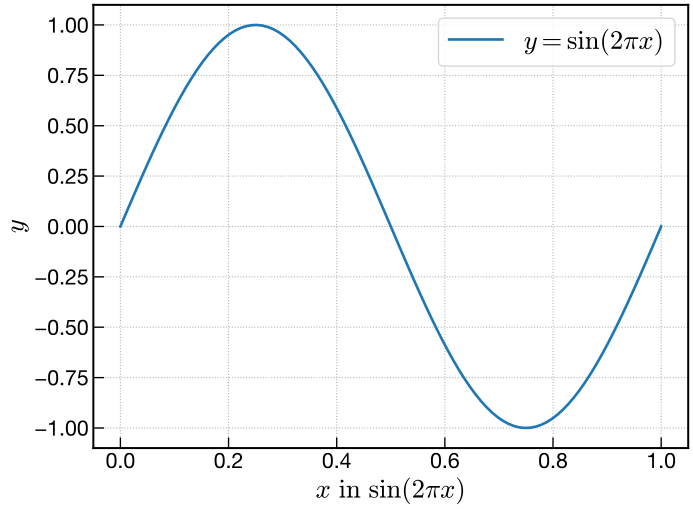
$$ y = \sin(2\pi x) $$y = np.sin(2 * np.pi * x) # 要素数100の1次元配列- sin関数は
np.sin() - 円周率は
np.pi - \(x\) が1次元配列なので \(y\) も1次元配列になる
プロット #
ここに出てくる出力例は よく使う設定と保存 の設定も用いている.
fig, ax = plt.subplots(1, 1)
ax.plot(x, y, label=r'$y = \sin(2\pi x)$')
ax.set_xlabel(r'$x \ \mathrm{in} \ \sin(2\pi x)$')
ax.set_ylabel(r'$y$')
ax.legend()